Investment needs
Private Equity Investments
Investing directly in companies
Investing outside public markets

Investing outside public markets
An equity investment in a non-listed company is an entrepreneurial form of investment that differs fundamentally from exchange-traded assets. The investor acquires shares directly in the company and thereby becomes a co-owner under corporate law. The economic development of the investment does not depend on short-term market movements or daily price quotations, but on the operational performance of the company itself.
Central factors include market positioning, innovative strength, management quality, capital structure and strategic milestones. Value develops through revenue growth, operational progress, regulatory approvals, market entries and structural transactions. Private equity is therefore shaped less by liquidity and more by entrepreneurial substance.
Particularly within the Swiss Life Sciences and Healthcare environment, many companies remain in development or growth phases over extended periods, during which private equity plays a central role. Direct investments allow investors to participate in such development processes at an early stage.
What a direct investment requires
Private equity investments are generally long-term in nature. As no organised secondary market exists, invested capital is typically committed for several years. An early exit may be limited or not possible at all. Investors should therefore only commit capital that is not required in the short term.
A direct investment also requires an appropriate understanding of risk. Non-listed companies are often in growth or transformation phases. Strategic plans may be delayed, market conditions may change and regulatory processes may take longer than expected. Such factors can materially influence the development of the company and the value of the investment.
Private equity is therefore particularly suitable for investors who wish to complement their portfolio with entrepreneurial engagements and who are prepared to follow economic developments over several years.

The investment process
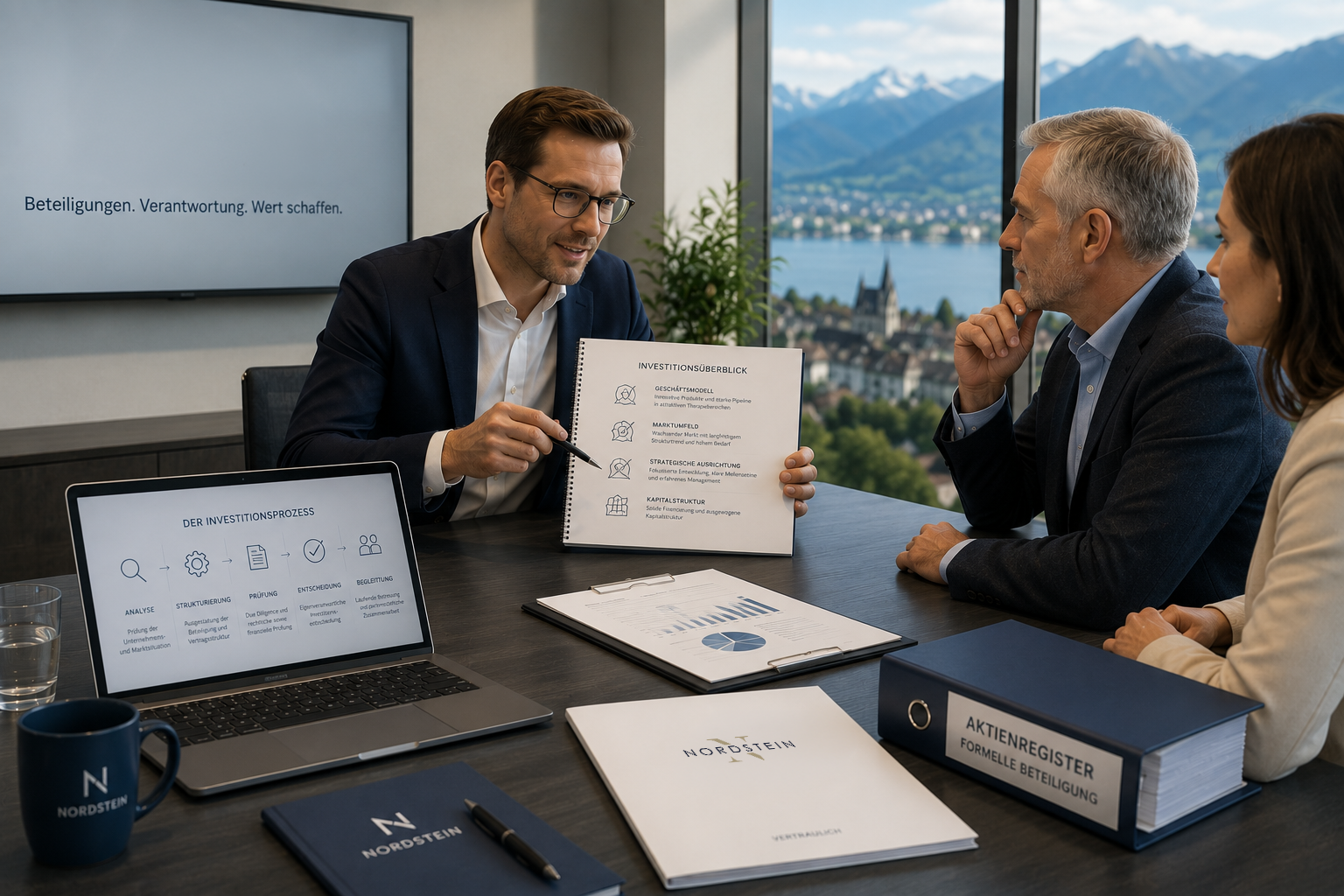
In the context of a potential investment, Nordstein provides interested parties with structured information on the respective company. This includes details on the business model, market environment, strategic direction and current capital structure.
In personal discussions, the underlying economic situation is explained and the key opportunities and risks are presented transparently. The aim is to provide the investor with a clear and traceable basis for decision-making. The investment decision rests solely with the investor.
Once an investment is made, the investor acquires shares directly in the company. Entry in the share register establishes the formal participation. The investor receives economic rights, that is, a share in the financial results of the company, and, where applicable, voting rights in accordance with the articles of association.
Nordstein accompanies the process from an organisational perspective and coordinates communication between the company and the investor. Even after the transaction has been completed, Nordstein remains a point of contact within the framework of ongoing investor support.
Long-term perspective and exit scenarios
In the private equity environment, the economic realisation of value typically occurs in connection with a structured event. Examples include a sale to a strategic investor, the entry of an institutional partner, a secondary sale of shares or an initial public offering.
The timing of such an event is often difficult to plan far in advance and depends on numerous factors, including the operational development of the company, market conditions, the regulatory environment and the strategic options available to the company. Investors should therefore plan for a multi-year holding period.
Private equity investments are not designed for short-term liquidity, but for entrepreneurial development.